
DVS Deep Dive 2026-22 | Graphite: The Battery Metal Hiding in Plain Sight

What a strange part of the cycle we are in. On the one hand, the broader commodity setup continues to look increasingly attractive on a long-term relative basis. Energy, metals and agricultural inputs are still nowhere near the kind of broad institutional ownership you would expect if the market was already fully pricing in the next commodity cycle. On the other hand, a lot of individual “battery metal” stories have been absolutely destroyed over the past two years.
Lithium went from market darling to graveyard. Nickel became a lesson in Indonesia, oversupply and why cost curves matter. Cobalt remains structurally complicated. Even copper, which is probably the cleanest long-term electrification metal, has had several false starts along the way. This is why I don’t think investors should approach the next phase of the cycle by simply buying anything with a battery label on it. That worked in 2020 and 2021. It has not worked since.
Against that backdrop, graphite is one of the more interesting materials to revisit. Not because it is flashy, and not because the equity charts have been easy. They haven’t. Graphite has been frustrating, opaque and in many cases deeply underwhelming. But that is exactly why it deserves a deeper look. It sits at the intersection of batteries, steel, industrial supply chains, China concentration, export controls and Western reshoring policy, yet it still receives a fraction of the attention that lithium, copper or uranium attract.
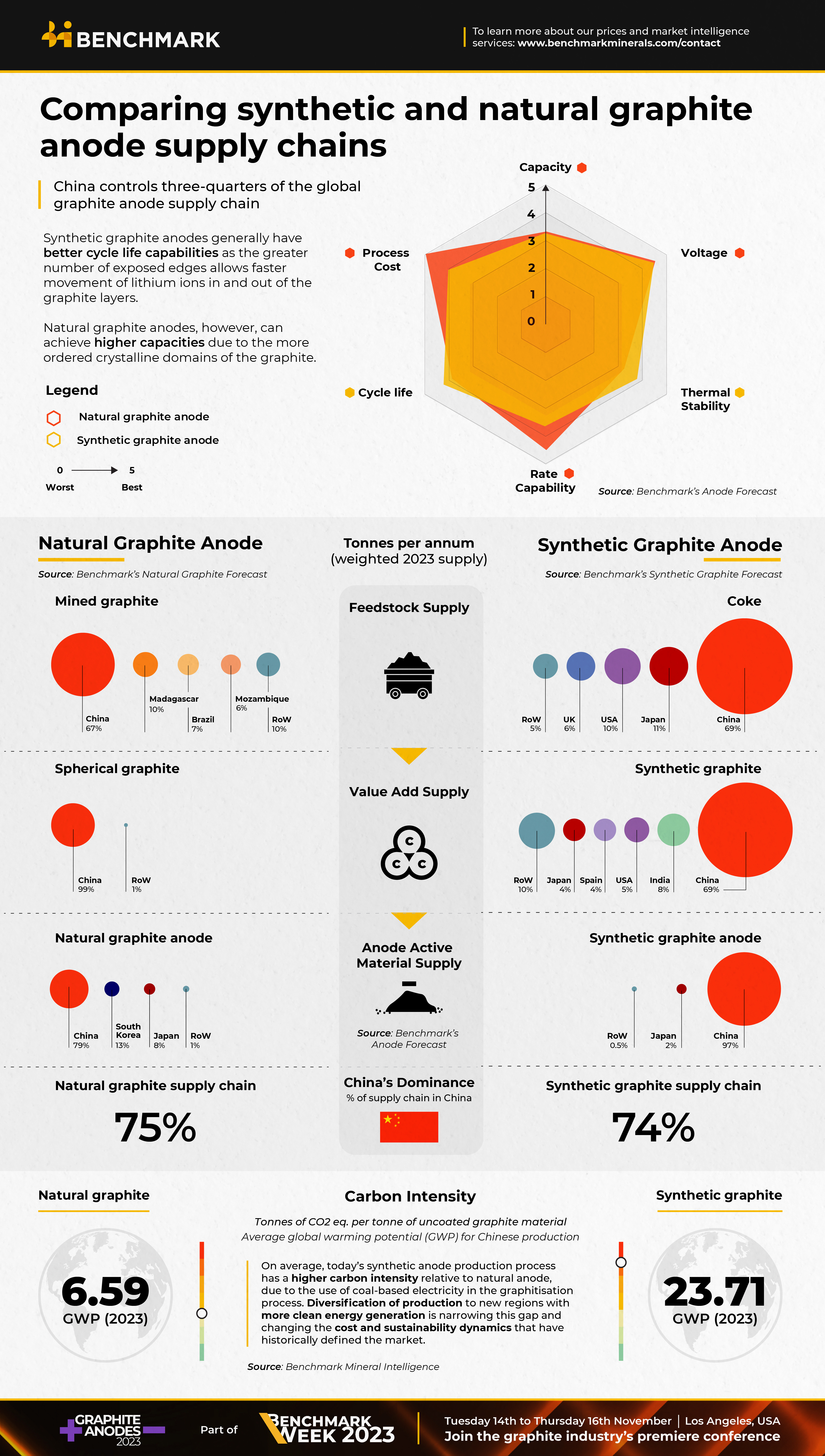
Graphite is one of those commodities that looks simple on the surface and gets more complicated the longer you study it. Investors often reduce it to “the stuff inside battery anodes,” which is partly true, but not enough. The material also shows up in refractories, steelmaking, foundries, lubricants, brake linings, fuel cells, nuclear applications, semiconductors and defense-related supply chains. In other words, graphite is not some speculative battery-only material. It was industrially relevant long before EVs became a market obsession.
The battery angle, however, is what changed the strategic conversation. In a lithium-ion battery, graphite is still the dominant anode material. Silicon can be blended in. Sodium-ion can eventually take some share. Solid-state can change part of the discussion. But for the commercial battery market as it exists today, graphite remains one of the key volume inputs. That makes it strange that graphite is often treated as the forgotten battery metal. Lithium gets the headlines, nickel gets the chemistry debate, cobalt gets the ESG debate, and copper gets the grid-electrification narrative. Graphite sits quietly in the background, despite being absolutely central to the battery supply chain.
Graphite | the quiet anode material the battery world still runs on
Graphite is a crystalline form of carbon, but from an investment perspective the first thing to understand is that “graphite” is not one simple product. Natural graphite is mined, concentrated and then potentially upgraded for battery use. Synthetic graphite is manufactured from carbon-rich feedstocks and requires energy-intensive graphitisation. Both can be used in anodes, both have advantages, and both have very different cost, emissions and supply-chain profiles.
That is why I don’t like the simplistic “natural graphite wins” or “synthetic graphite wins” framing. The real battery market does not work that way. Cell makers care about consistency, purity, performance, cost, qualification, cycle life, supply reliability and customer requirements. They can blend natural and synthetic graphite, they can optimise for different battery chemistries, and they can change specifications over time.
So the real question is not whether a company owns a graphite deposit. The real question is whether that company can move from a deposit to a qualified battery material that customers are actually willing to use at scale. That is a much higher bar.
This is where graphite becomes different from many other mining stories. With gold, investors can often start with grade, ounces, jurisdiction, capex, recovery and mine life. With copper, the playbook is more complicated but still broadly understood. With graphite, the rock is only the beginning. The real value chain runs through processing, purification, spheronisation, coating and customer qualification. That is where the bottleneck sits, and that is where most junior graphite stories either become real or quietly fall apart.
Where graphite shows up without you noticing
Battery anodes are the obvious growth market, but graphite’s industrial base matters because it gives the commodity a broader demand foundation than many investors assume.
In steel and refractories, graphite is used because it can handle extreme heat and chemical stress. In foundries, lubricants and friction materials, it benefits from thermal stability, conductivity and layered crystal structure. In nuclear and defense applications, graphite can become strategically relevant because of its thermal properties and role in specialised systems. In fuel cells and advanced electronics, it sits closer to the next-gen materials stack.
But the battery market is the big swing factor. Every time people talk about EVs, battery storage, energy security and Western battery independence, graphite should be part of that conversation. You cannot have a serious battery supply-chain discussion while ignoring the anode. And you cannot have a serious anode discussion while ignoring China’s dominance in graphite processing.
That is the core tension in graphite today: the material is strategically essential, but the market structure is still heavily controlled by one country and one downstream ecosystem. The West may want battery independence, but graphite shows how far away that goal still is.
The value chain is where the story gets interesting
The easiest mistake in graphite is to stop at the mine. A company announces a large resource, investors look at the tonnes, and the story sounds compelling. But battery-grade graphite is not produced by simply digging up rock and shipping concentrate into the EV supply chain.
For battery anode use, the material typically has to move through several stages: mining, crushing, grinding, flotation, concentration, spheronisation, purification, coating and then qualification with customers. Each step can introduce cost, technical risk and execution risk. A project can have a large resource and still struggle if the flake size distribution is poor, if impurities are difficult to remove, if purification is expensive, if the required chemicals or energy inputs create cost pressure, or if the final product fails customer qualification.
This is also why graphite metallurgy and processing should receive more attention than the market usually gives them. The economic question is not just “how much graphite is in the ground?” It is “what product can this project actually produce, how consistently, at what cost, and for which end market?” That distinction matters enormously.
A graphite concentrate going into industrial markets is not the same as spherical purified graphite going into battery anodes. A company with a mine is not automatically a battery-materials company. A company with a resource is not automatically a supplier to Panasonic, LG, CATL, Samsung SDI, Tesla or any other serious customer. The qualification process is real, and for battery materials it can take years.
That makes graphite a much more selective equity market than many investors want it to be. The theme can be right while the wrong equities still go nowhere.
Supply concentration: China is the center of gravity
Graphite is one of the clearest examples of how critical-mineral policy sounds simple in speeches and becomes extremely complicated in practice. The US and Europe can talk about reshoring, friendshoring and battery independence, but graphite exposes the gap between ambition and reality.
China dominates natural graphite production. More importantly, it dominates the downstream steps that matter for battery anodes: purification, spheronisation, coating, graphitisation and active anode material production. That means a Western graphite mine does not solve the problem by itself. If the material still has to move through China-linked processing to become battery-ready, the supply chain remains exposed.
This is why graphite is not just a mining story. It is a processing story, a permitting story, a chemical story, a customer qualification story and a geopolitical story. The mine matters, but the downstream chain matters more.
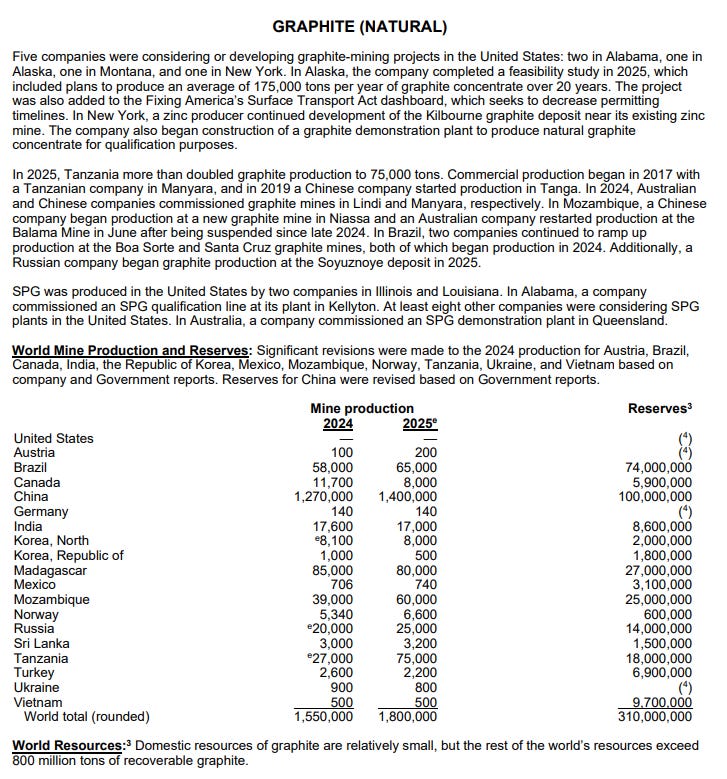
The numbers are the point. The United States still has no meaningful domestic natural graphite production and remains fully import-reliant. China remains the dominant producer. And once you move downstream into anode materials, the concentration becomes even more important.
This is where graphite starts to look less like a boring industrial mineral and more like a strategic pressure point. If China tightens exports, restricts processing technology, prioritises domestic customers, changes licensing rules or simply keeps pricing pressure high enough to make Western projects uneconomic, the entire non-Chinese battery chain has a problem.
That does not mean graphite prices have to explode tomorrow. It means the strategic value of secure supply is higher than the headline market currently suggests.
Africa, North America and Australia are trying to enter the chat
Outside China, the most obvious graphite development regions are Africa, North America and Australia. Africa already matters because countries like Mozambique, Madagascar and Tanzania have natural graphite production and development potential. Canada is trying to position itself as a cleaner and more secure battery-material jurisdiction. The US has strategic urgency but very limited domestic supply today. Australia has graphite potential as well, but faces the same challenge as everyone else: mining is only step one.
The problem is not a lack of graphite in the ground. The problem is building a complete, financeable, qualified and competitive supply chain outside China. That requires mines, processing facilities, chemical inputs, energy, environmental permits, customer qualification and long-term capital. It also requires buyers who are willing to pay for non-Chinese supply, even when Chinese material is cheaper.
That last point is important. Investors often assume Western OEMs will automatically pay up for secure supply. In practice, they still care about cost. A Western graphite project can be strategically attractive and still struggle if its product is too expensive, if financing is too dilutive, or if customers are unwilling to sign binding agreements at prices that support the required capex.
This is the same lesson we have seen across other battery materials. Policy support matters, but policy support alone does not turn a bad project into a good one.
Pricing: opaque, fragmented and not always helpful
Graphite is frustrating because there is no single clean price that tells you everything. There is no graphite equivalent of watching copper on the LME or oil on NYMEX. Pricing varies by product type, purity, flake size, carbon content, geography, processing stage and end-use market.
Natural flake graphite is not the same product as spherical purified graphite. Battery-grade active anode material is not the same product as industrial concentrate. Synthetic graphite has its own cost structure and dynamics. This makes graphite harder to analyse from the outside, because the price that matters depends entirely on what the company can actually produce and sell.
This is why broad graphite bullishness can be dangerous. A company can say it is exposed to graphite, but the relevant question is which graphite product, at which stage of the value chain, with which customers, and with what margin structure. Without that, investors can end up buying a story rather than a business.
The recent cycle has made this very clear. Graphite has remained strategically important, but many graphite equities have performed terribly. That is not a contradiction. A commodity can be critical while the equity market punishes companies with weak balance sheets, large funding gaps, unclear customer pathways or no credible downstream strategy.
In that sense, graphite is similar to several other critical minerals. The macro story gets people interested. The project-level economics determine who survives.
Where are we in the graphite cycle?
High level, I do not think graphite is in the euphoric phase of the cycle. Far from it. Sentiment is still weak, many equities remain broken, and the market is not broadly rewarding the theme in the way it rewarded battery metals in 2020 or 2021.
That is not necessarily a negative.
In fact, this is often the stage where the more interesting work starts. The easy money has left. The weak stories have been exposed. The market has stopped buying every powerpoint deck with “critical minerals” in the title. And now the only names that deserve attention are the ones with real scale, real processing logic, real customer relevance, real funding options and a credible route into the anode chain.
That is the setup I prefer. I do not want a hot theme where everyone already agrees. I want an essential material, ugly sentiment, concentrated supply, Western policy pressure and a narrow list of companies that might actually matter.
Graphite fits that description.
The challenge is selection. This is not a commodity where I would blindly buy the highest-torque junior. Some juniors will work, especially if the market starts paying up for non-Chinese supply again, but the larger opportunity may be in understanding where the real value sits in the chain.
And in graphite, the answer is clear: the value is not just in the ground. It is in turning graphite into qualified anode material at scale.
What I want in a graphite equity
For me, the graphite screen is more demanding than a basic resource screen. I want to see either real production, downstream processing capability, customer qualification progress, credible offtake, strong jurisdictional relevance, balance sheet survivability, or a genuine pathway into battery-grade material.
A large resource helps, but it is not enough. A good jurisdiction helps, but it is not enough. A nice presentation helps, but it is definitely not enough. The company needs to answer the uncomfortable questions: who will buy the material, in what form, at what price, under what qualification process, and with what capital required to get there?
That is where most graphite stories become less exciting. But it is also where the better ones start to stand out.
This is why I think graphite should be approached in two layers. First, understand the commodity and the strategic supply-chain problem. Second, separate the companies that merely own graphite from the companies that can actually participate in the anode-material value chain.
That distinction is everything.
For the broader audience, the main takeaway is simple: graphite is not dead, but the lazy version of the graphite trade probably is. The next phase will not reward every deposit equally. It will reward scale, processing, qualification, funding access and strategic relevance.
For subscribers, I’ll take that framework one step further and move from the commodity story into the equity side: the Western graphite name I currently think gives the cleanest exposure to this theme.
Not the most speculative name. Not necessarily the highest-torque junior. But the company that, in my view, best combines jurisdiction, strategic relevance, downstream ambition, customer validation and a credible route into the non-Chinese anode supply chain.
That distinction matters in graphite. This is not a market where I want to simply chase the smallest explorer with the nicest resource slide. The opportunity is bigger than that, but so are the execution risks. The real question is which company can move beyond “we have graphite in the ground” and actually become relevant to the battery-materials chain.
That brings me to my preferred Western graphite name.