

Following the first two names in this series, I want to keep moving through the handful of micro-cap situations that I think currently offer some of the better risk/reward asymmetries at the very speculative end of the portfolio.
So far, the first two picks have moved quickly. The previous silver pick has traded more than 50% above where I first highlighted it, while the copper pick has gained more than 20% and is holding up well so far.
Those numbers sound large in isolation, but that needs some context.
When a stock is coming off a genuinely distressed base - particularly when the relative chart versus the underlying commodity is still sitting near long-term lows - a 20–50% move can still represent only a small part of the potential rerating. The ratio charts further below illustrate that point particularly well.
I did reduce a little exposure into strength after those moves, simply because taking some risk off after a very rapid rerating makes sense to me. But I am still holding the vast majority of the shares, particularly given what increasingly looks like a reacceleration in the broader commodity bull market.
That is ultimately what this series is about.
I am not trying to find stocks that have already been perfectly repriced. I am looking for small companies where the starting valuation remains distressed enough that even an initial rerating can leave substantial upside if the underlying thesis continues to improve.
This next company currently sits at #2 on my silver micro-cap list.
Importantly, the difference between #2 and the company I currently have at #3 is not really a large difference in underlying quality. Fundamentally, I think they compare surprisingly well.
The reason I give this one the edge is more practical: it is the more established ticker, has a longer trading history and generally offers better liquidity. With companies this small, that matters.
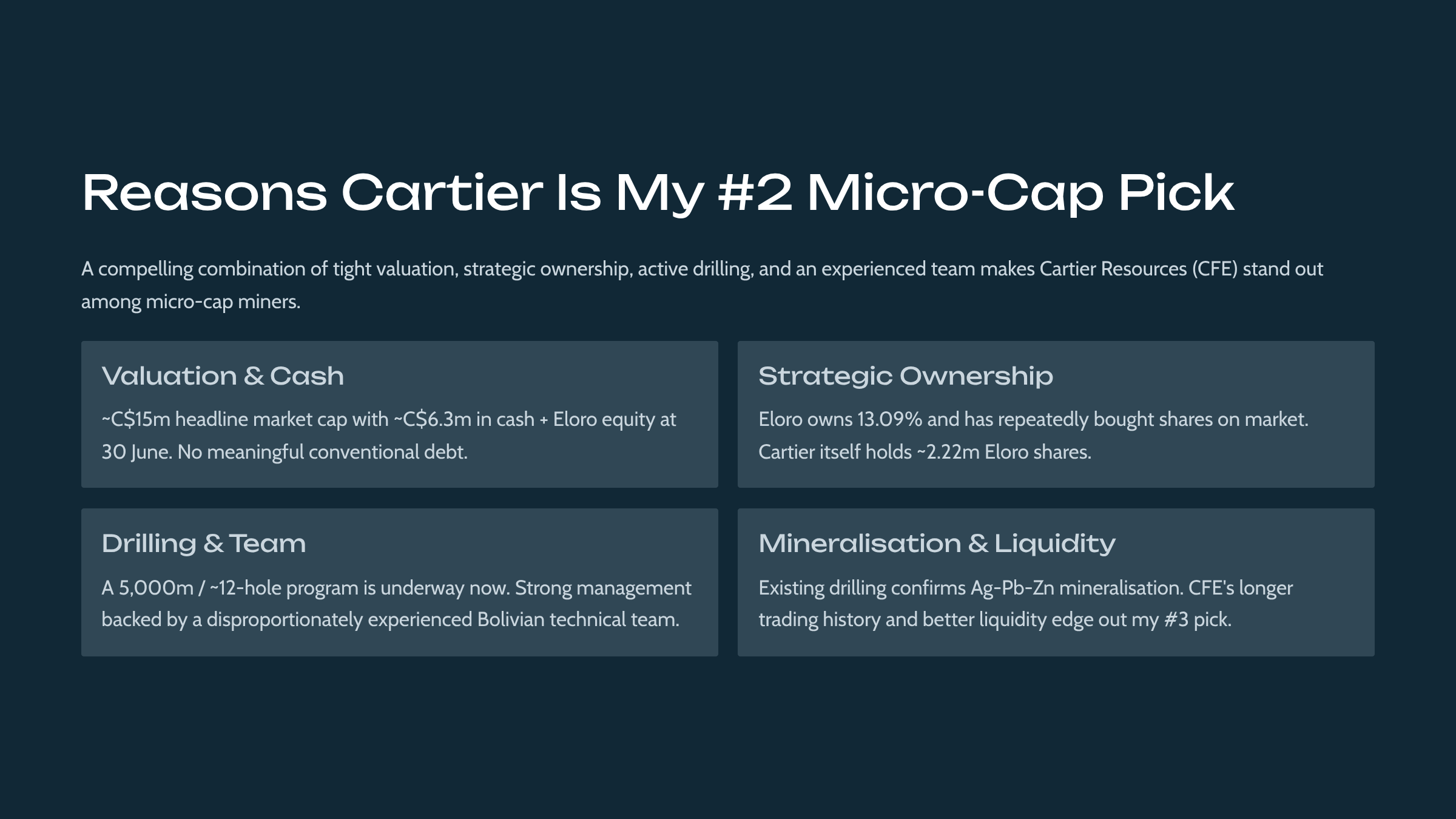
The company itself is currently worth only around the mid-C$10 millions, yet underneath that tiny valuation sits considerably more substance than I would normally expect from a company of this size:
a strong treasury relative to the market cap;
meaningful exposure to a listed strategic investment;
essentially no conventional debt;
an active drill campaign targeting an already mineralised polymetallic system;
previously demonstrated high-grade silver-dominant mineralisation;
and backing from a much larger, strategically connected resource company that has continued adding shares in the open market.
That final point was particularly interesting to me. The relationship goes considerably deeper than a passive investment, and it is one of the reasons this company moved materially higher on my list once I started digging into it.
Add the valuation, the active catalyst window and the deeply depressed relative chart shown further below, and I think the setup becomes very interesting.
A few things I want to keep front and centre with this series:
20–50% moves can look huge, but from distressed bases they do not necessarily mean the rerating is finished.
The ratio charts matter just as much as the standalone price charts.
I will still de-risk selectively into strength, particularly after very fast moves.
But as long as the commodity backdrop remains constructive and the underlying thesis keeps improving, I am comfortable keeping the majority of the position intact.
These remain small speculative allocations, not Core 15-sized positions.
Paid subscribers get the ticker and full thesis first. This post will be opened to everyone afterwards.
Cartier Silver | CSE: CFE
Cartier Silver is a Canadian-listed exploration company whose primary value driver is the Chorrillos silver-lead-zinc project in southern Bolivia, approximately 15–20km from Eloro Resources’ Iska Iska silver-tin polymetallic system.
The company also owns the Big Easy gold-silver project in Newfoundland and iron-rich assets in the Labrador Trough, but I am assigning relatively little value to those today.
Chorrillos is why I am interested.
What makes Cartier unusual at this valuation is that I do not have to rely on one single argument. The balance sheet is interesting, the first drilling has already demonstrated grade, the next drill program is underway, the technical team is substantially stronger than the market capitalisation might suggest, and the relationship with Eloro is considerably deeper than simply operating nearby.
The Chart | A More Established Micro-Cap Setup
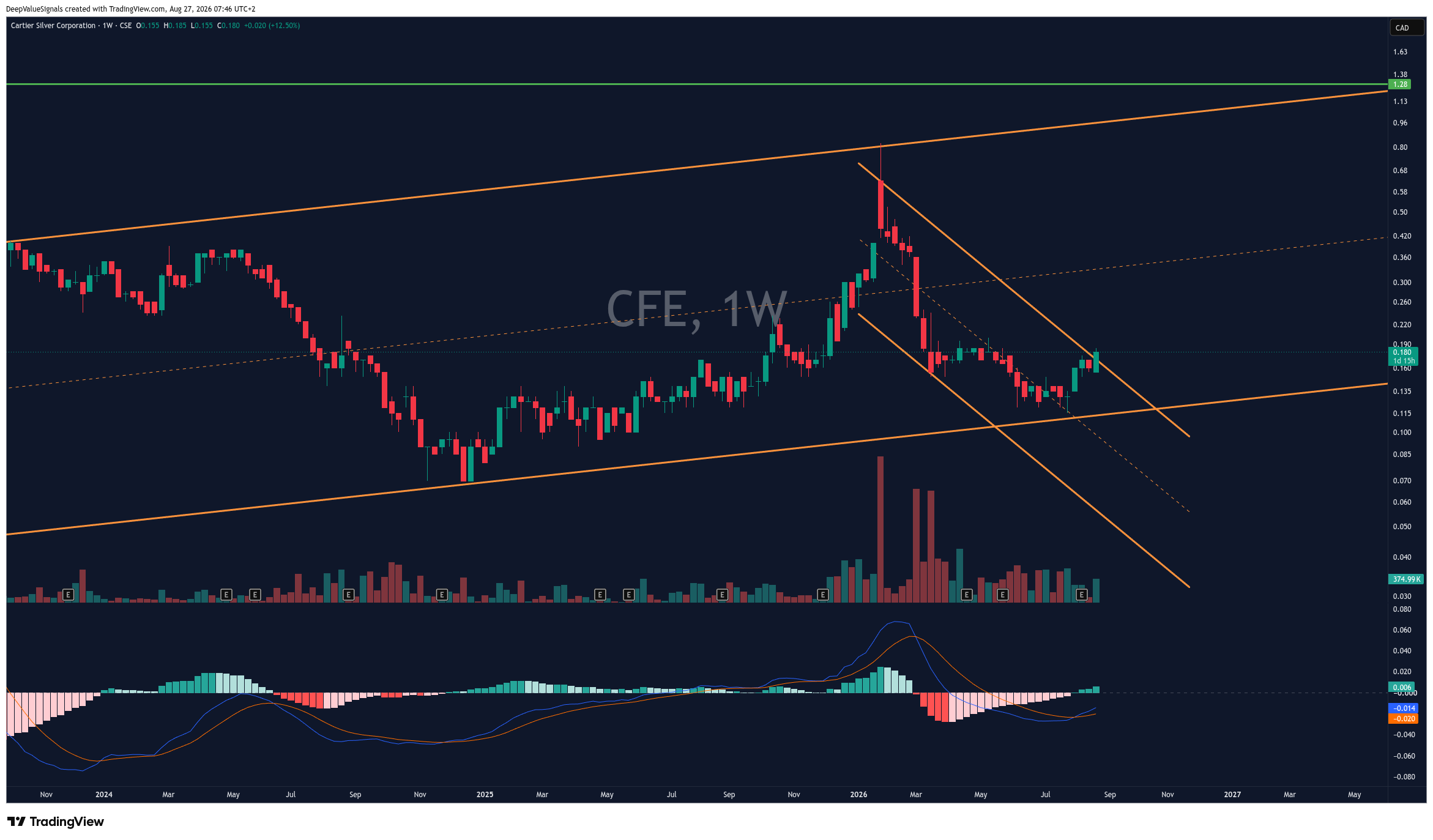
CFE went through a major rerating into early 2026, briefly spiking to around C$0.80, before correcting all the way back toward C$0.11–0.12, where it found support around the lower boundary of the larger rising structure.
Price has since recovered toward C$0.18 and is now testing the descending trendline that has capped the entire correction. Weekly momentum is also beginning to improve.
For me, C$0.18–0.20 is the key area. A convincing weekly breakout would materially improve the structure and could open the way back toward C$0.22–0.26, followed by the C$0.30+ area if momentum builds.
Not confirmed yet, but this is exactly where I like these setups: deep retracement, larger support holding, and price beginning to challenge the corrective trend.
CFE / SILJ | The Relative Disconnect
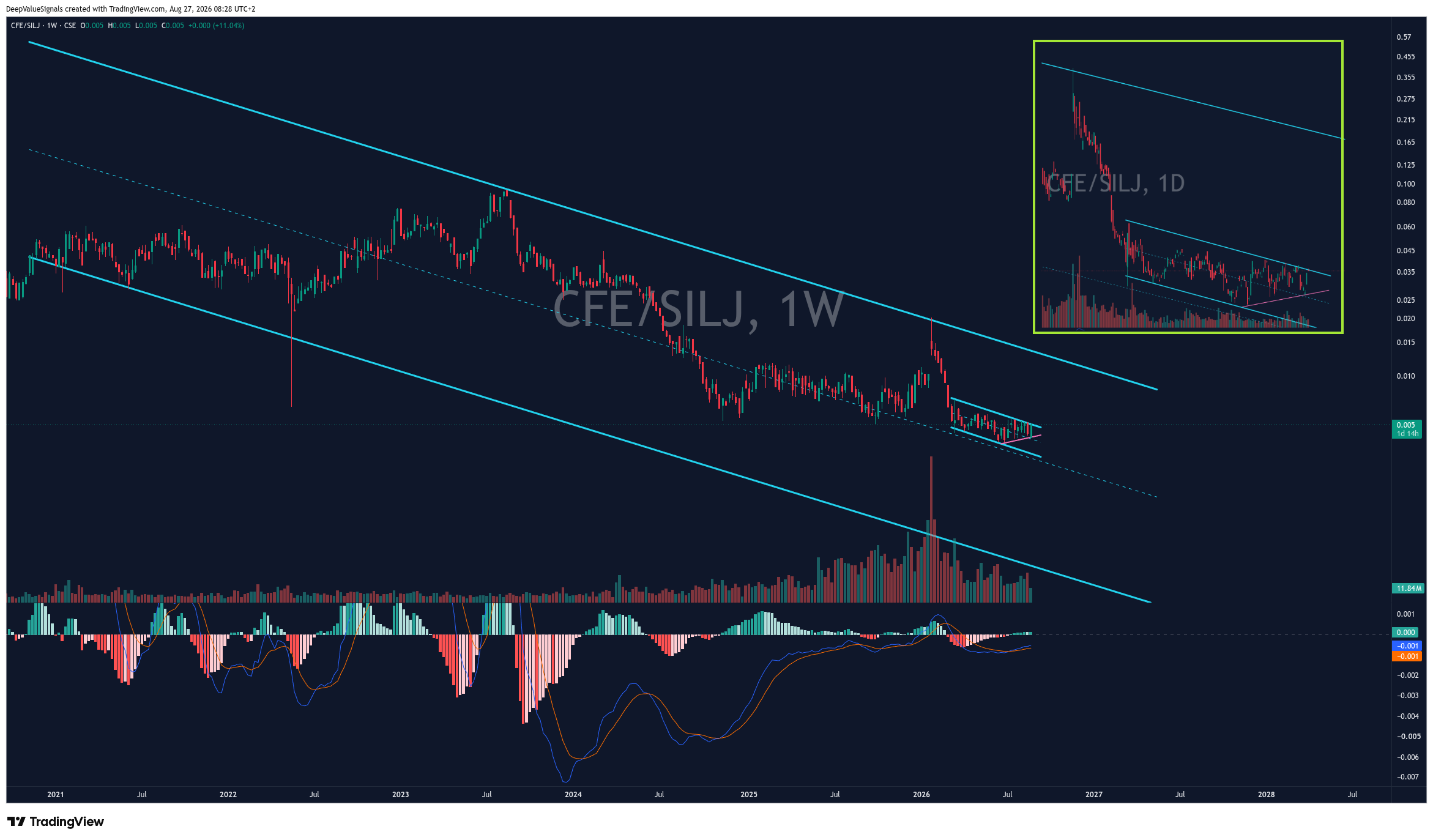
The ratio chart makes the distortion even clearer.
CFE has massively underperformed SILJ over the past several years and is still sitting near the lower end of a long-term descending structure. More recently, however, the ratio has started compressing into a much tighter formation near those lows.
That matters because even a 20–50% move in the stock can still represent only a small repair of the relative underperformance.
A break from the current compression would be particularly interesting because it would suggest CFE is beginning to outperform the junior-silver sector rather than simply rising alongside it.
That is the kind of confirmation I want to see if the broader rerating thesis is going to develop.
The Valuation Setup | More Backing Than the Headline Market Cap Suggests
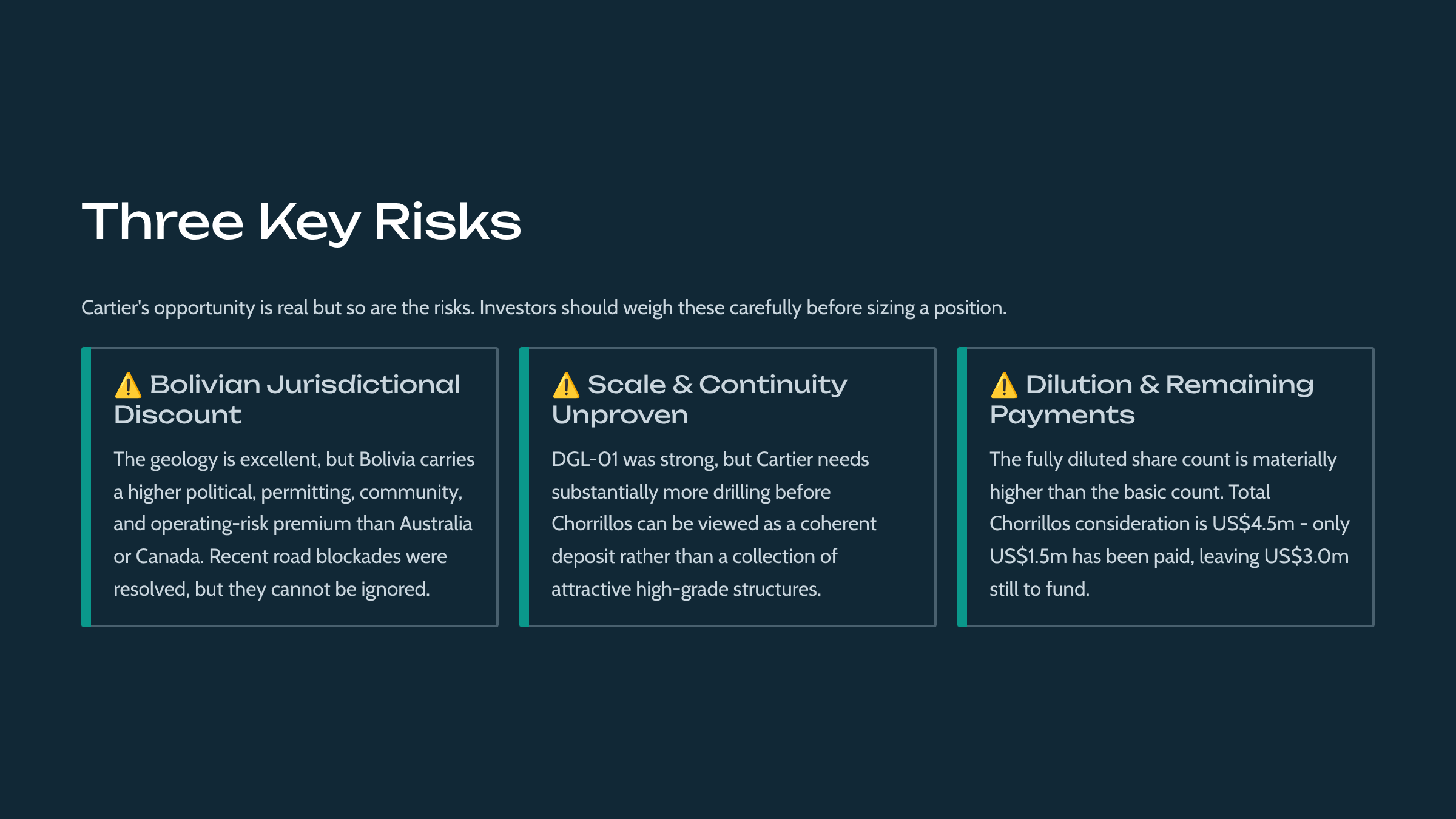
Cartier currently has 84.45 million basic shares outstanding, with approximately 15.35 million warrants and 8.28 million options, taking the fully diluted count to roughly 108.1 million shares. The company reports no conventional debt.
At a share price around the high-teens cents, that puts the headline equity valuation in roughly the C$15 million area.
That is small enough on its own. But the balance sheet makes it more interesting.
The fresher 30 June financial information, disclosed through Eloro’s quarterly filing because Eloro accounts for Cartier as an associate, shows Cartier with approximately:
C$2.02m cash
C$4.35m investment in Eloro Resources
approximately C$0.28m other current assets
and only around C$0.32m current liabilities.
So you have roughly C$6.3m of cash + listed Eloro equity sitting underneath a company worth only around C$15m.
I would not mechanically subtract every dollar and call the remainder a precise enterprise value. Cartier is actively drilling, cash is being spent, the Eloro shareholding moves with ELO’s share price and there are still Chorrillos acquisition payments outstanding.
But the broader point remains: a surprisingly large portion of the current equity value is backed by liquid or near-liquid financial assets before assigning much value to the actual silver project.
That is unusual for something this small.
Chorrillos | The Geological Starting Point
Chorrillos consists of the optioned Gonalbert and Felicidad areas together with three additional staked properties.
Cartier’s Bolivian subsidiary has now paid US$1.5m toward the option agreements and owns 70% of the vendor entities. It can move to 100% through total staged consideration of US$4.5m by June 2028.
So the project is not completely paid for yet, and that needs to remain part of the risk assessment. Geologically, however, this is not simply a collection of unexplained anomalies.
The area sits within a major Bolivian polymetallic corridor, with widespread silver-lead-zinc mineralisation associated with epithermal veins, stockworks and disseminated systems. Gonalbert itself contains historical artisanal workings, while Felicidad has also seen previous small-scale extraction of silver-rich galena veins.
Cartier’s first drill campaign then demonstrated that significant mineralisation extends beyond those historical workings.
Discovery hole DGL-01 returned:
44.76m @ 49.19g/t Ag + 1.35% Zn + 1.31% Pb including: 5.60m @ 137.42g/t Ag + 7.91% Zn + 5.60% Pb.
Another zone in the same hole returned: 18.25m @ 57.74g/t Ag + 1.75% Pb, including: 6.63m @ 79.90g/t Ag + 2.53% Pb.
Subsequent work also produced: 11.09m @ 109.54g/t Ag + 3.68% Zn + 4.44% Pb, including: 5.81m @ 170.01g/t Ag + 2.51% Zn + 7.00% Pb.
I do not consider those spectacular because of silver grade alone.
The important thing is the combined polymetallic value across meaningful widths.
This is not necessarily a thesis that requires Cartier to repeatedly discover one-metre bonanza veins at 2,000g/t silver. Lead and zinc contribute materially to the rock value, while the geological team has also discussed the possibility of deeper tin-related mineralisation.
There is still a lot left to prove. But there is enough geological substance here that the next drill campaign matters.
Why 2026 Matters | The Drill Is Turning Now
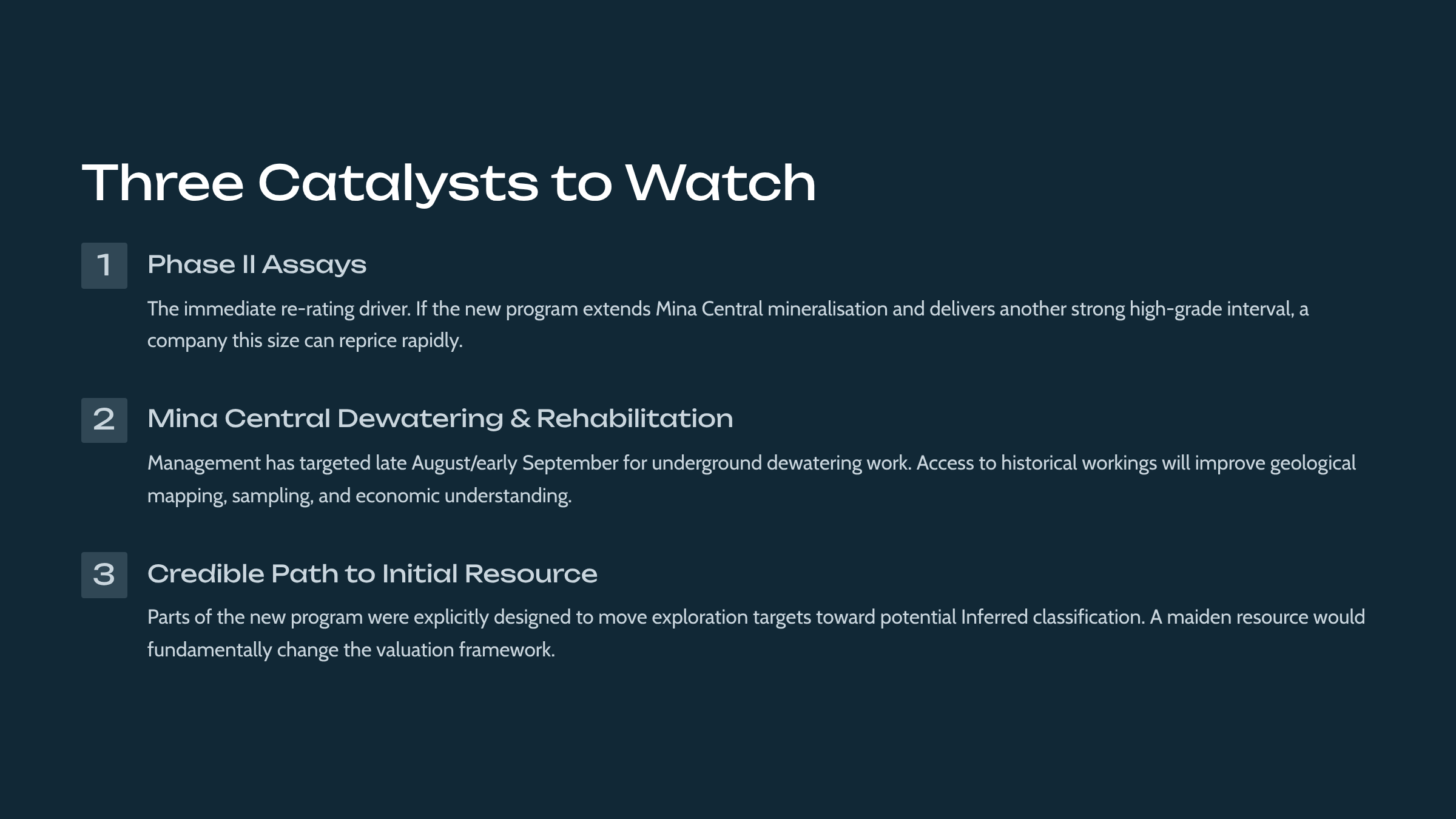
This is probably the most important near-term element of the thesis.
Cartier commenced its second-phase 5,000m diamond drill program in July, comprising approximately 12 holes and expected to continue through Q4.
The program is not simply repeating DGL-01.
It is testing multiple parts of the system:
extensions around Mina Central
mineralisation beneath the historical Quimbalete/Hoyada workings
new parallel structures
and first-pass drilling at Felicidad.
Management has explicitly stated that part of the program is designed to move selected exploration targets toward potential Inferred Mineral Resources.
That is exactly what I want from a company in this valuation bracket. There is already enough evidence to justify drilling, but not enough drilling yet for the market to confidently value the system.
Successful Phase II results can begin closing that gap.
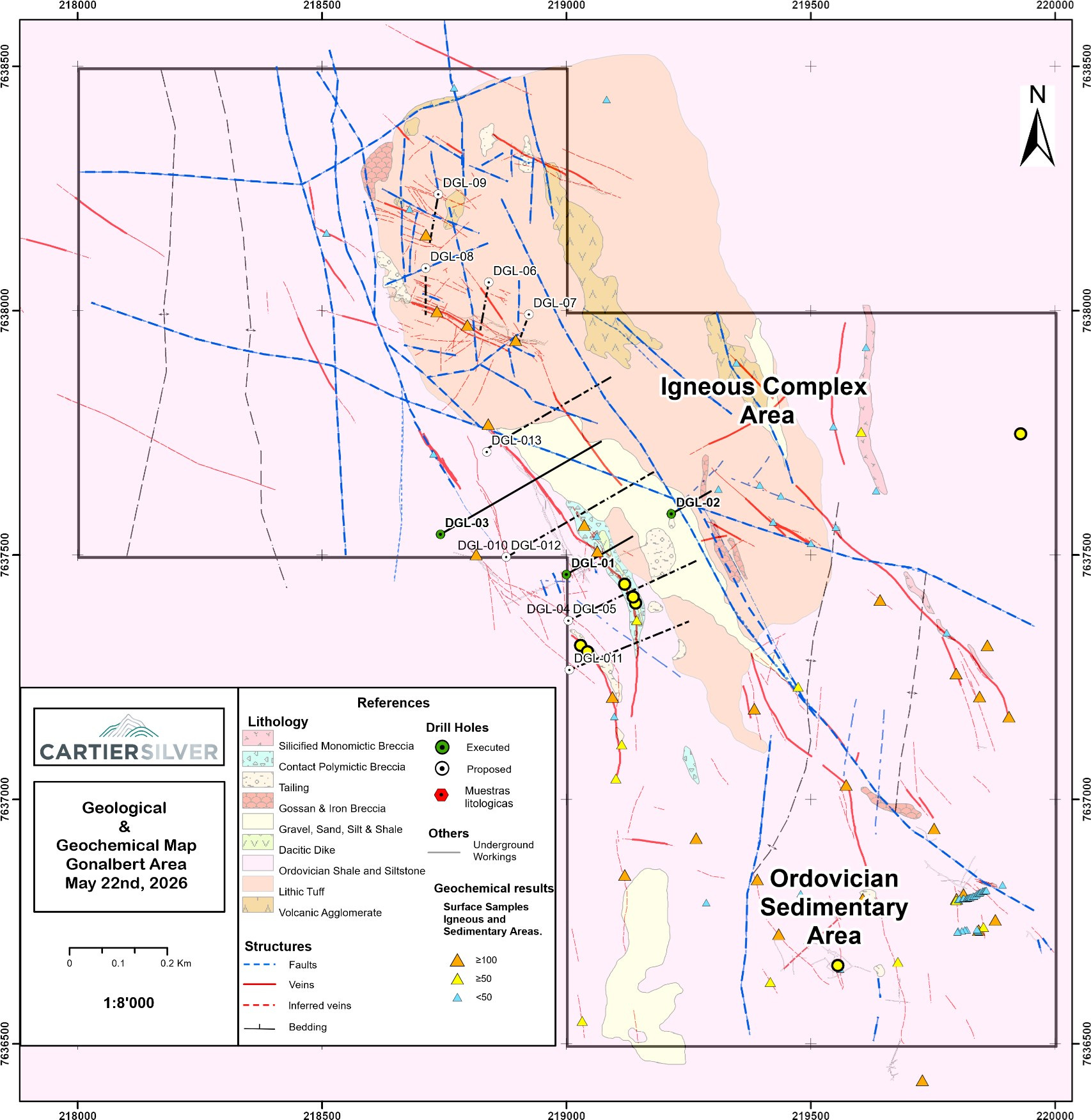
Gonalbert geological plan showing completed and proposed diamond drill holes across the Chorrillos Project. Source: Cartier Silver, May 2026.
The Eloro Connection | Stronger Than I Initially Thought
This is probably my favourite non-geological part of the story. Eloro Resources is not simply a neighbouring company. The relationship is deeply intertwined.
Eloro initially participated in Cartier’s financing, then in March 2026 purchased another 1.205 million shares in the open market at C$0.17–0.21, spending approximately C$218,000.
And importantly, Eloro kept buying after that.
After 30 June, Eloro purchased another 1.061 million Cartier shares in the open market for approximately C$139,000.
As of 12 August 2026, Eloro held: 11,054,500 CFE shares representing: 13.09% of Cartier Silver.
That is a meaningful update from the ~11.8% position shown in older materials.
There are also 2.4 million Cartier warrants held by Eloro at C$0.20, creating further potential alignment if CFE moves higher. A strategic investor participating in a financing is useful.
A strategic investor subsequently going into the open market on multiple occasions and continuing to increase its ownership is considerably more interesting.
And the relationship goes deeper still. Cartier CEO Thomas Larsen is also Chairman and CEO of Eloro, while key Bolivian geologist Dr. Osvaldo Arce works across the technical programs and brings more than three decades of Bolivian geological experience.
Cartier’s technical roster also includes Dr. Bill Pearson and Dr. Quinton Hennigh, the latter acting as geological and technical adviser to Crescat Capital, a strategic shareholder.
In other words, this is a ~C$15m micro-cap with a technical bench that looks considerably more substantial than the valuation would suggest.
And Cartier Owns Eloro Too
There is also a cross-holding in the other direction.
Cartier’s current corporate profile states that it owns approximately 2.22 million Eloro shares.
At 30 June, the balance-sheet value of that Eloro investment was approximately C$4.35 million.
So the strategic relationship is unusually tight:
Eloro owns >13% of Cartier.
Cartier owns millions of dollars of Eloro stock.
They share senior people.
They share Bolivian technical expertise.
And their flagship projects sit only around 15–20km apart.
I do not regard that as a guarantee of a transaction or corporate combination.
There is no basis to claim one is imminent.
But I absolutely regard the relationship as meaningful strategic validation.
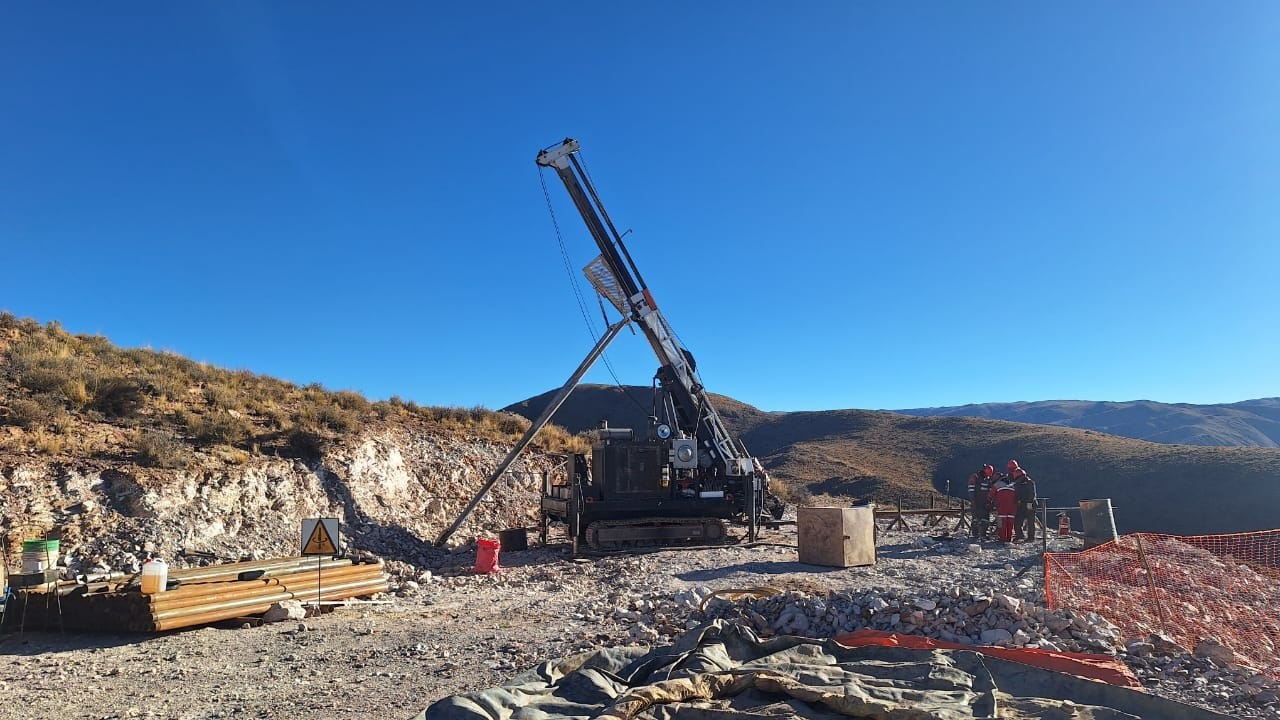
Fujita drill rig on site at Chorrillos as Cartier commenced its second-phase 5,000m campaign. Source: Cartier Silver, July 2026.
Management, Backing & Skin in the Game
Management is one of the cleaner parts of the setup, although I would frame “skin in the game” slightly differently here than with a founder-controlled explorer.
Thomas Larsen has more than three decades of investment and resource-sector experience and has specialised heavily in raising capital and managing junior mining companies. Cartier itself says he has raised more than C$150m over his career.
The geological side is arguably more important to me.
Dr. Osvaldo Arce has extensive Bolivian exploration experience and is one of the key technical links between Cartier and Eloro. Dr. Bill Pearson has more than 40 years of global exploration and production experience, while Quinton Hennigh brings another high-profile exploration background through Crescat and several major discovery stories.
Crescat itself also remains an investor in Cartier according to its 2026 precious-metals holdings disclosures.
I would therefore not oversell direct management common-share ownership.
The stronger alignment case is: Eloro >13% strategic ownership + repeated open-market purchases + Crescat involvement + shared management + shared geological expertise.
The Capital Structure | Not Perfect, But Manageable
Cartier has roughly:
84.45m basic shares
15.35m warrants
8.28m options
and approximately: 108.1m fully diluted shares.
That means there is warrant and option overhang.
The warrants range roughly between C$0.125 and C$0.30, meaning some become increasingly relevant as the share price rises.
On the other hand, warrant exercise would also bring additional cash into the business. The February financing is particularly worth highlighting.
Cartier raised C$3m at C$0.30 per share, importantly using straight common shares rather than attaching warrants.
That means investors put substantial capital into the company at a price materially above where CFE subsequently traded. I do not interpret that as proof that the stock must return to C$0.30.
But it does tell me today’s investor is entering at a materially different valuation than investors who funded the company only months ago.
Bottom Line
Cartier is currently my #2 micro-cap lottery-ticket setup.
The reason it sits at #2 rather than #3 is not because I see a huge quality gap between the two. Fundamentally, I think the next company matches up surprisingly well.
I simply give Cartier the edge because it has a more established trading history, somewhat better liquidity and a very unusual amount of strategic and balance-sheet backing for a company this small.
At roughly a mid-C$10m valuation, what I am effectively getting is:
~C$2m cash
~C$4.35m of Eloro equity
minimal liabilities
demonstrated high-grade polymetallic mineralisation
an active 5,000m drill campaign
a project sitting 15–20km from Iska Iska
a disproportionately experienced technical team
and Eloro itself now owning 13.09% after repeatedly buying more CFE in the open market.
That final point deserves emphasis. Eloro did not simply make one strategic investment and move on. It kept buying.
That does not make Cartier risk-free, and it certainly does not prove Chorrillos will become an economic mine. Bolivia deserves a discount, the deposit still needs considerably more drilling and the remaining property payments matter.
But for this series, I am not looking for situations where every uncertainty has already disappeared.
I am looking for small companies where enough substance already exists to protect the thesis, while one or two genuine geological successes can potentially transform the valuation.
Cartier fits that framework extremely well.
Now the drill bit needs to prove the scale. And if Phase II begins doing exactly that, a ~C$15m market capitalisation could start looking very small very quickly.